
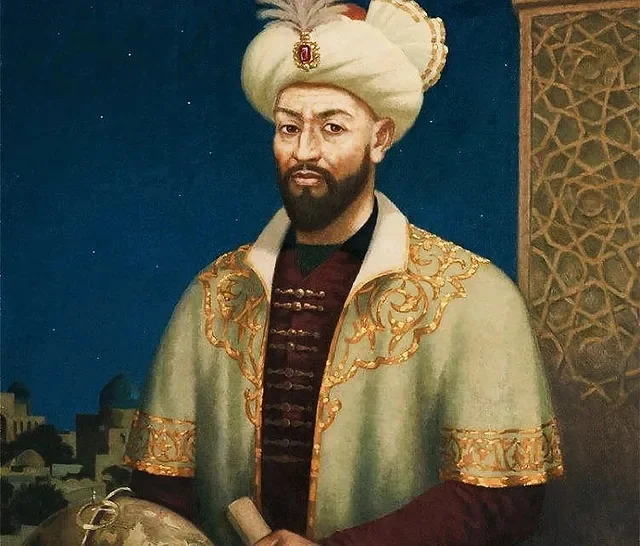
Timur's grandson, who governed Samarkand but was far more interested in the sky. He built an observatory with a sextant sunk into bedrock and measured the stars for two decades.
A prince among scholars
Muhammad Taraghay, called Ulugh Beg — "the great prince" — was born in 1394 in Sultaniyeh during one of Timur's campaigns and grew up at his grandfather's moving court. In 1409, at fifteen, his father Shah Rukh made him governor of Samarkand. He ruled the city for forty years and filled it with scholars.
The madrasa and the observatory
In 1417–1420 he built his madrasa on the Registan, where he taught mathematics himself; its façade still faces the square. On a hill outside the city he then built an observatory with a meridian arc some forty metres in radius cut into the rock. With al-Kashi, Qadizada al-Rumi and Ali Qushchi he produced the Zij-i Sultani — the most accurate star catalogue between Ptolemy and Tycho Brahe.
A murdered king, a buried arc
His rule ended in tragedy. In 1449 his own son Abd al-Latif rebelled, and Ulugh Beg, setting out on pilgrimage, was murdered on his son's orders. The observatory was wrecked and forgotten until 1908, when the archaeologist Vasily Vyatkin found the buried arc. His remains were identified in the Gur-e Amir in 1941; today he is honoured as one of Samarkand's greatest sons.
Key achievements
- Compiled the Zij-i Sultani star catalogue of over a thousand stars in 1437
- Calculated the length of the sidereal year to within about a minute of the modern value
- Built the Samarkand observatory, whose sextant arc still survives