
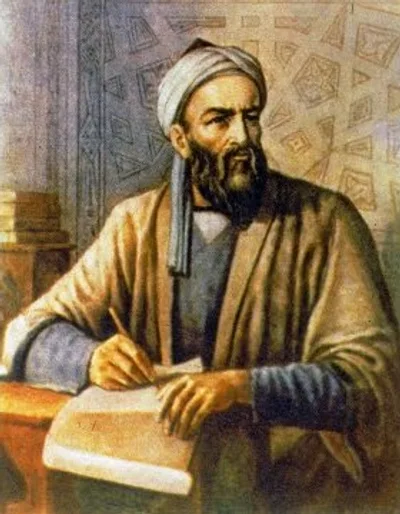
Born in Khwarezm, he measured the Earth's radius from a mountaintop, learned Sanskrit to study India on its own terms, and wrote about Hindu belief without condescension.
A scholar of Khorezm
Abu Rayhan al-Biruni was born in 973 near Kath, the old capital of Khorezm, and trained under the mathematician Abu Nasr Mansur. As a young man he exchanged a famous series of letters with Ibn Sino, challenging Aristotle's physics — can the heavens have weight, can a vacuum exist? He served the Khorezmshahs until 1017, when Mahmud of Ghazni conquered the country and took him away.
Measuring the Earth
In Mahmud's service he travelled with the army into India. Near the fort of Nandana, in today's Pakistan, he measured the dip of the horizon from a mountaintop and calculated the Earth's radius at about 6,340 kilometres — less than one per cent from the modern figure. He also wrote al-Qanun al-Mas'udi, an encyclopaedia of astronomy, and a mineralogy that recorded the densities of metals and gems.
India on its own terms
His most remarkable book was on India. He learned Sanskrit, read the sources himself and described Indian philosophy, astronomy and customs with a fairness rare in any age, comparing them patiently with Greek ideas rather than mocking them. He died in Ghazni around 1048. Today a city in Karakalpakstan and Tashkent's Institute of Oriental Studies bear his name, and so does a crater on the Moon.
Key achievements
- Estimated the Earth's radius to within a fraction of a percent of the modern figure
- Wrote Tarikh al-Hind, a study of Indian science, religion and custom
- Argued that the Earth rotates on its own axis, centuries before it was accepted