
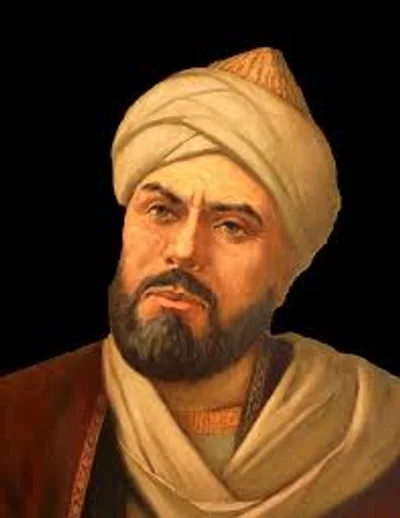
An astronomer from the Fergana Valley who worked at the House of Wisdom in Baghdad. His summary of Ptolemy's astronomy, known in Latin as Alfraganus, was read in European universities for centuries.
From Fergana to Baghdad
Abu'l-Abbas Ahmad al-Farghani was born in the Fergana Valley around the turn of the ninth century and joined the astronomers the caliph al-Ma'mun gathered in Baghdad. They checked Ptolemy's tables against fresh observations and replaced the Greek figures where they failed. Al-Farghani's particular talent was explanation: he could make a difficult system readable.
The textbook of the heavens
His Elements of Astronomy laid out the Ptolemaic universe without heavy mathematics: the spheres, the motions of the planets, the size of the Earth, the climates. Translated into Latin in the twelfth century by John of Seville and Gerard of Cremona, it became one of the standard astronomy books of medieval Europe, and Dante cites "Alfragano" in his Convivio.
Columbus's miscalculation
Al-Farghani reported that one degree of the meridian measured 56⅔ miles — Arabic miles, each far longer than the Roman mile. Centuries later Christopher Columbus read the figure as Roman miles, concluded the Earth was much smaller than it is, and argued that Asia lay within easy sailing distance to the west. Late in life al-Farghani went to Egypt, where in 861 he supervised the building of the Great Nilometer on Roda Island.
Key achievements
- Wrote the Elements of Astronomy, read for centuries in Europe under the name Alfraganus
- Reported the caliph al-Ma'mun's measurement of a degree of the meridian
- Supervised the building of the Great Nilometer on Roda Island in Cairo in 861