
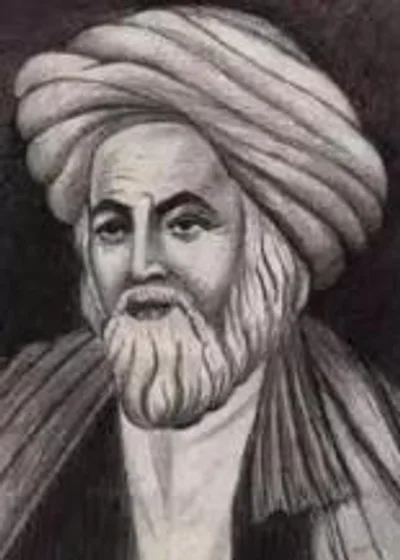
Born in Khorezm, he wrote al-Kashshaf, one of the most celebrated commentaries on the Quran, together with influential works on Arabic grammar and rhetoric.
A boy from Zamakhshar
Abu'l-Qasim Mahmud al-Zamakhshari was born in 1075 in Zamakhshar, a village in Khorezm. As a young man he lost a leg — to frostbite on a winter journey, by his own account — and walked with a wooden one for the rest of his life. He studied in Bukhara and Baghdad and became one of the finest writers of Arabic prose in his age, although Arabic was not his mother tongue.
The Kashshaf
His great commentary on the Qur'an, al-Kashshaf — "The Revealer" — finished in Mecca in 1134, explains the text above all through its language: grammar, rhetoric and the precise weight of words. Its theology was Mu'tazili, which later Sunni scholars criticised, but its linguistic analysis was so admired that they went on teaching it — often with corrective notes of their own.
Neighbour of God
He lived so long beside the Kaaba that he was called Jarullah — "God's neighbour". Besides the Kashshaf he wrote al-Mufassal, a grammar still studied, and Asas al-Balagha, a dictionary that sets each word's literal meaning beside its figurative uses. He returned to Khorezm at the end of his life and died in Gurganj, today's Urgench, in 1144.
Key achievements
- Wrote al-Kashshaf, a celebrated commentary on the language and rhetoric of the Qur'an
- Wrote al-Mufassal, a concise grammar of Arabic studied for centuries
- Compiled Asas al-Balagha, a dictionary that separates literal and figurative meanings