
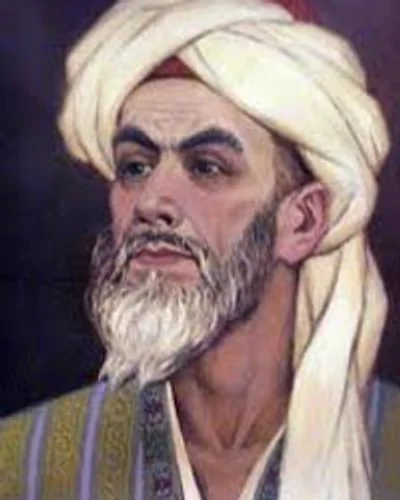
Author of Qutadgu Bilig ('Wisdom That Brings Happiness'), completed around 1070 — one of the earliest great works of Turkic literature, a long poem on just rule and the good life.
A poet from Balasagun
Yusuf was born around 1019 in Balasagun, a Karakhanid city in the Chu valley of today's Kyrgyzstan. Little is known of his life beyond what the poem reveals: a man steeped in Arabic and Persian learning who chose, deliberately, to write in his own Turkic language. He completed his great work in Kashgar around 1069–1070 and presented it to the Karakhanid ruler.
Wisdom that brings happiness
Qutadgu Bilig runs to more than six thousand couplets. Its four characters stand for ideas: the king Kuntogdi for justice, the vizier Oytoldi for fortune, his son Ogdulmish for intellect, and the hermit Odgurmish for contentment and the afterlife. Through their conversations the poem asks how a ruler should govern, how officials should behave and how a person should live well.
Three manuscripts
The ruler was so pleased that he gave the author the title Khass Hajib — chamberlain of the inner court — by which he has been known ever since. Three manuscripts of the poem survive: one in Vienna, one in Cairo and one found in Namangan, now kept in Tashkent. Today Qutadgu Bilig is a shared classic of the Uzbek, Uyghur, Kyrgyz, Kazakh and other Turkic peoples.
Key achievements
- Wrote Qutadgu Bilig (c. 1069–70), one of the earliest great works of Turkic literature
- Set out a model of just government through the dialogues of four allegorical characters
- Was honoured with the title Khass Hajib — chamberlain of the royal court — for the poem