
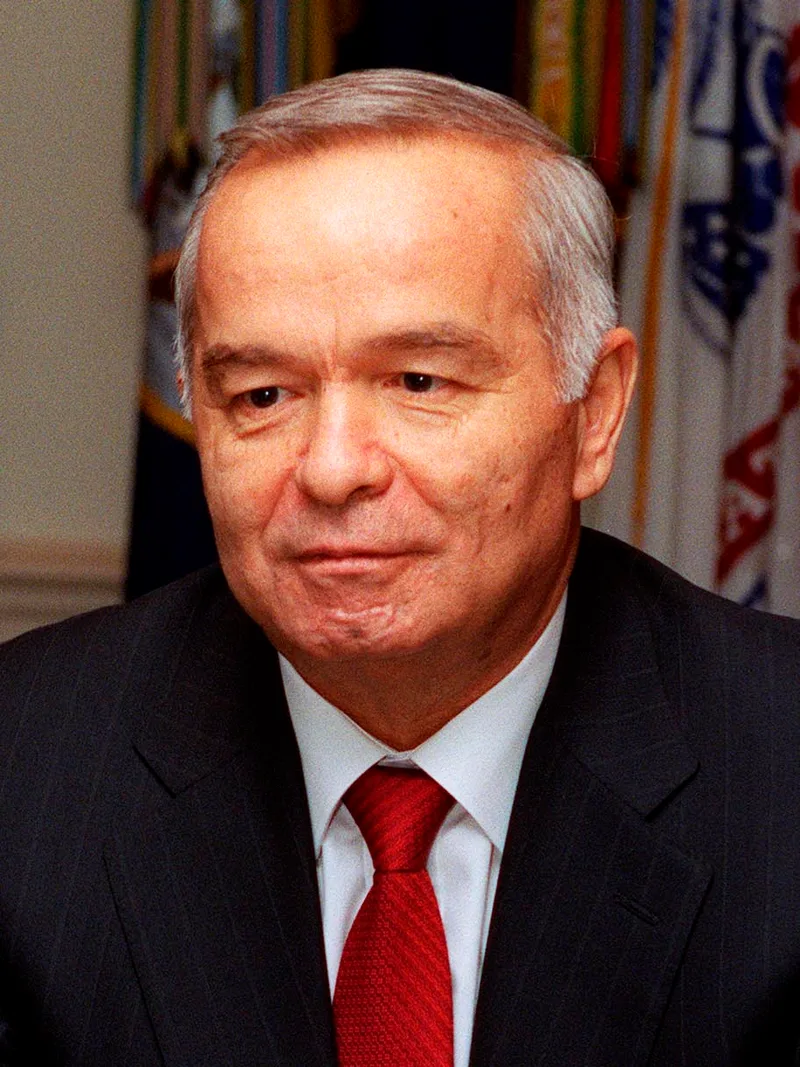
Born in Samarkand and trained as an engineer and economist, he led Uzbekistan from the Soviet dissolution through its first twenty-five years as an independent state.
Samarkand beginnings
Islam Abdug'aniyevich Karimov was born in Samarkand on 30 January 1938 and spent part of his childhood in a Soviet children's home. He trained as a mechanical engineer at the Central Asian Polytechnic Institute, graduating in 1960, and later took a second degree in economics at the Tashkent Institute of National Economy.
He began his working life as an engineer, first at the Tashselmash agricultural machinery plant and then at the Chkalov aviation factory in Tashkent.
A Soviet economist
In 1966 he moved to the State Planning Committee of the Uzbek SSR, where he spent almost twenty years and rose to first deputy chairman. He became the republic's Minister of Finance in 1983, deputy chairman of its Council of Ministers, and in 1986 First Secretary of the Communist Party in the Kashkadarya region.
In June 1989 he was made First Secretary of the Communist Party of Uzbekistan, and in March 1990 the republic's Supreme Soviet elected him to the new post of President of the Uzbek SSR.
Independence
On 31 August 1991, as the Soviet Union came apart, the Supreme Council declared Uzbekistan independent; 1 September became Independence Day. On 29 December 1991 Karimov won the first popular presidential election.
The new state needed everything a state needs. A constitution was adopted on 8 December 1992; a national currency, the som, replaced the rouble — first as a transitional coupon in 1993, then in its permanent form on 1 July 1994. A new flag, coat of arms and anthem followed, and Uzbek was given a Latin alphabet.
The "Uzbek model"
Karimov rejected the shock therapy tried elsewhere in the former Soviet Union in favour of what he called a gradual, state-led transition. The state kept firm control of cotton, gold, gas and foreign exchange, while the country worked to become self-sufficient in grain and fuel.
The approach avoided the deep collapse some neighbours went through, but it also meant a closed currency market, a heavily regulated economy and, in the cotton fields, the mobilisation of students and public employees for the harvest — a practice that drew international criticism for years.
History and heritage
The independence years put history at the centre of national identity. Amir Temur was restored as a national hero: the 660th anniversary of his birth was marked in 1996, when the Amir Temur Museum opened in Tashkent. Anniversaries followed for Bukhara and Khiva (2,500 years, 1997), Samarkand (2,750 years, 2007) and Tashkent (2,200 years, 2009), each with large restoration programmes.
In 1997 the National Programme for Personnel Training reorganised schooling, adding academic lyceums and vocational colleges to make twelve years of education universal.
Security and criticism
Karimov's rule was defined as much by control as by construction. After bombings in Tashkent in February 1999 and armed incursions in 1999 and 2000, the government made security its overriding priority. In May 2005, troops fired on a crowd in Andijan after an armed uprising in the city; the government gave a toll of 187, while human rights groups put it far higher, and the events brought sanctions and years of strained relations with the West.
Political opposition and independent media had little room under him, and his terms were extended by referendums in 1995 and 2002. He was re-elected in 2000, 2007 and 2015.
Death and memory
Karimov died on 2 September 2016 after a stroke, aged 78, and was buried in Samarkand beside the Hazrati Khizr mosque, where a memorial complex now stands. Tashkent's international airport bears his name.
He was married to Tatyana Karimova, an economist, and had two daughters. He remains the man who took Uzbekistan out of the Soviet Union and built its institutions — and, in the view of his critics, the author of a closed and repressive system that his successor set out to open.
Key achievements
- Led the country through independence in 1991 and the transition that followed
- Oversaw the introduction of the som as the national currency in 1994
- Directed the restoration of major heritage sites in Samarkand, Bukhara and Khiva