
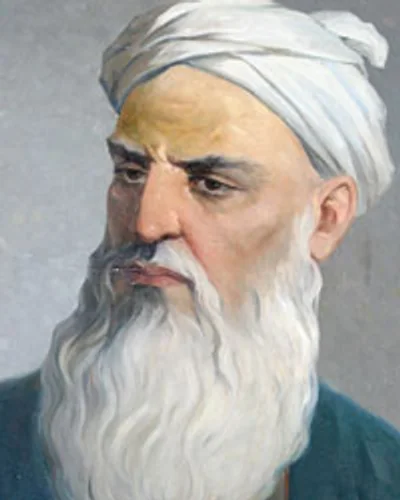
Court poet of the Samanids in Bukhara, honoured as the father of classical Persian poetry. Only a small part of his work survives, yet his verse set the pattern for the poets who followed.
From Panjrud to Bukhara
Abu Abdullah Rudaki was born around 858 in Panjrud, a village in the upper Zarafshan valley. He became known young for his voice and his playing of the chang, a kind of harp, and was called to Bukhara, the Samanid capital, where the emir Nasr II made him his court poet. He grew famously rich — legends tell of the long caravans needed to carry his possessions.
The poem that brought the emir home
The best-known story about him: the emir lingered so long in Herat that his homesick courtiers begged Rudaki for help. He composed a poem beginning "The scent of the Muliyan stream comes to me" and sang it to the chang. The emir, it is said, leapt onto his horse without stopping to put on his boots and rode straight back to Bukhara.
What survives
Tradition credits him with an enormous output, yet only about a thousand lines survive, scattered through anthologies and dictionaries. They are enough to show the clarity and warmth that made him the model for Firdawsi, Hafiz and every Persian-language poet after him. Late in life he is said to have lost favour at court; he died in his native village in 941, where his mausoleum stands today.
Key achievements
- Shaped the ghazal, qasida and ruba'i as forms of classical Persian verse at the Samanid court
- Put the fables of Kalila and Dimna into verse
- Honoured in Uzbekistan, Tajikistan and Iran as the first great poet of the Persian language