
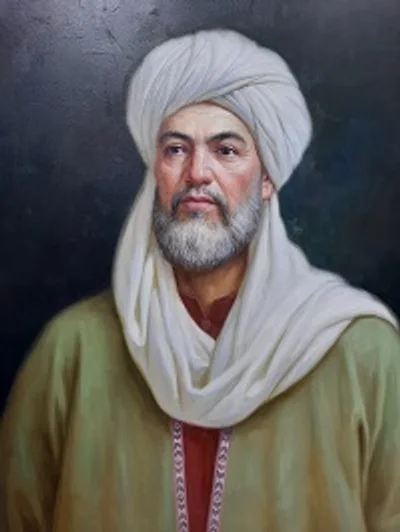
Born in Bukhara, he spent sixteen years travelling and cross-checking narrations, discarding all but a small fraction, and produced the collection Sunni Muslims rank second only to the Qur'an.
A boy with a memory
Muhammad ibn Ismail al-Bukhari was born in Bukhara in 810 and lost his father young; his mother raised him. By ten he was attending hadith classes, and by sixteen he had memorised the collections of earlier scholars. After the pilgrimage to Mecca he stayed on in the Hijaz and began the travels — to Baghdad, Basra, Kufa, Egypt and Syria — that filled the following decades.
Sixteen years of sifting
He is said to have heard some six hundred thousand narrations and kept only about seven thousand, counting repetitions, for his al-Jami' al-Sahih. His test was the chain of transmission: every narrator had to be trustworthy, and each had to have plausibly met the one before. The result, compiled over sixteen years, is regarded by Sunni Muslims as the most authentic book after the Qur'an.
Exile and Khartank
Fame brought conflict. When the governor of Bukhara demanded private lessons for his sons, al-Bukhari refused — knowledge, he said, should be taught openly — and he was forced to leave his home city. He died in 870 in the village of Khartank near Samarkand. The memorial complex around his grave, rebuilt on a grand scale in 1998 and expanded since, is one of the most visited places of pilgrimage in Uzbekistan.
Key achievements
- Compiled Sahih al-Bukhari, sifting hundreds of thousands of narrations
- Established rigorous criteria for authenticating a chain of transmission
- His shrine near Samarkand remains a major place of pilgrimage