
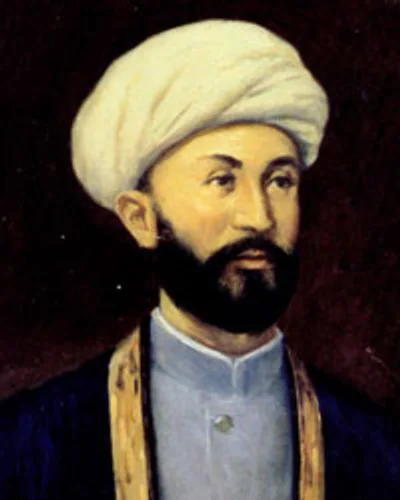
Born in 1862 at To'raqo'rg'on near Namangan, Ibrat studied in Kokand and then travelled unusually widely for his time — through Arabia, India and China — learning several languages on the way. He returned to open a new-method school, and in the early 1900s established Matbaai Ishoqiya, one of the first printing presses in the Fergana Valley. He wrote on language, history and culture, including a six-language dictionary, and served as a qazi. He was arrested during the purges and died in 1937.
The press that made the valley readable
Reform movements need paper. Before Ibrat, a book in the Fergana Valley was copied by hand or imported at cost, which meant that a new textbook was an idea rather than an object. Matbaai Ishoqiya changed the arithmetic: schools could be supplied, pamphlets could be argued over, and a poem written on Monday could be read in another town by Friday. He printed his own works and other people's, and the press did as much for the Jadid programme in the valley as any school he opened.
Six languages, one argument
Ibrat's dictionary — covering Arabic, Persian, Turkic, Russian, Hindi and English — looks like a reference work and functions like a manifesto. Its premise is that Turkestan's future depended on being able to read the world directly rather than through intermediaries, and that a merchant, a student or a judge should be able to reach for the word himself. His travel writing carried the same argument in narrative form: he had seen Bombay and Canton, and he wanted his readers to understand that the world was larger and stranger than the valley assumed.
Key achievements
- Founded Matbaai Ishoqiya, among the first printing presses in the Fergana Valley
- Compiled a six-language dictionary — Arabic, Persian, Turkic, Russian, Hindi and English
- Travelled through Arabia, India and China and wrote up what he saw for readers at home