
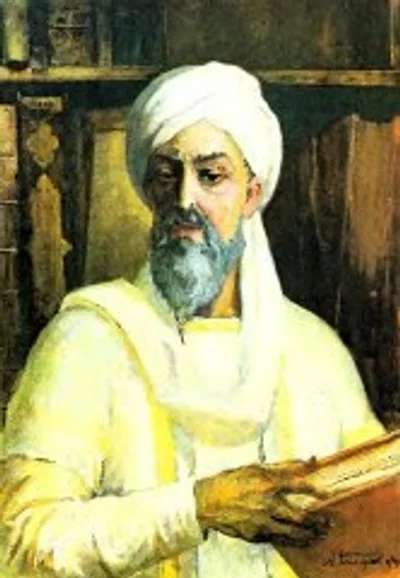
Born in a village outside Bukhara. He had read the whole of Aristotle's Metaphysics before he was eighteen, and went on to write a medical encyclopaedia Europe used for six centuries.
A prodigy from Afshona
Abu Ali ibn Sina was born in 980 in Afshona, a village near Bukhara. By ten he knew the Qur'an by heart; by sixteen he was treating patients. At seventeen he cured the Samanid emir Nuh ibn Mansur, and his reward was the run of the royal library in Bukhara — which, he later wrote, held books whose very names most people had never heard.
The Canon of Medicine
His Canon of Medicine, finished around 1025, gathered Greek, Indian and Islamic medicine into five books and added his own observations: that some diseases spread through water and soil, that tuberculosis is contagious, and how a new drug should be tested before it is trusted. Translated into Latin in the twelfth century, it was taught in European universities until the seventeenth.
A restless life
His life was anything but calm. After the fall of the Samanids he moved from court to court — Gurganj, Rayy, Hamadan, Isfahan — as physician and vizier, once hiding in an apothecary's house, once imprisoned in a fortress, writing all the while. He died in Hamadan in 1037, where his mausoleum stands. In Afshona, the village of his birth, a museum is dedicated to him.
Key achievements
- Wrote The Canon of Medicine, a standard European medical text into the 1600s
- Wrote The Book of Healing, a complete philosophical and scientific system
- Described contagion, clinical trials and the anatomy of the eye centuries early