
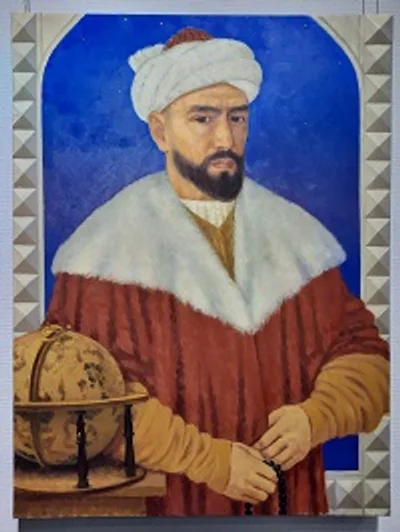
A student of Ulugh Beg who helped complete the Samarkand star tables. He later carried the Samarkand school of astronomy to Istanbul, where he taught at the Ottoman court.
The falconer's son
Ala al-Din Ali ibn Muhammad was born in Samarkand in 1403. His father was Ulugh Beg's falconer — "qushchi" means falconer — and the prince took the boy under his wing, placing him with Qadizada al-Rumi and al-Kashi. The story goes that he once slipped away to Kerman to study without permission, and came back with a treatise on the phases of the Moon that won his master's forgiveness.
Finishing the tables
At the Samarkand observatory he rose to be director, and after Qadizada's death he completed the Zij-i Sultani. In his own commentary on astronomy he argued that the science could stand on observation and mathematics without depending on Aristotle's natural philosophy — and even discussed whether the Earth might move — ideas historians see as a step towards modern science.
From Samarkand to Istanbul
After Ulugh Beg's murder he left Samarkand. He served the Aq Qoyunlu ruler Uzun Hasan and, sent as an envoy to Sultan Mehmed II, was invited to stay: from 1472 he taught at the Hagia Sophia madrasa in Istanbul, bringing Samarkand's science to the Ottoman world. He died there in 1474 and was buried in the cemetery of the Eyüp Sultan mosque.
Key achievements
- Completed the Zij-i Sultani star tables at the Samarkand observatory
- Argued that astronomy could rest on observation and mathematics alone, without Aristotle's philosophy
- Carried the Samarkand school of science to Istanbul, teaching at the Hagia Sophia madrasa