
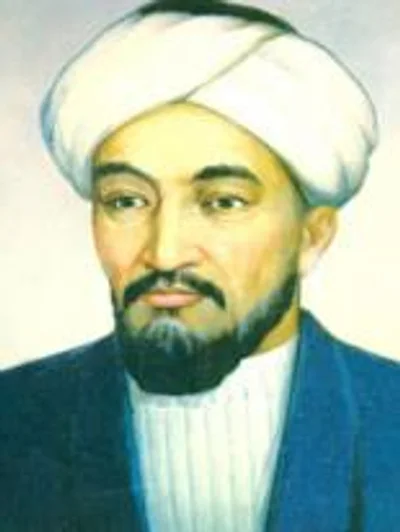
Known in the Islamic world as the 'Second Teacher' after Aristotle. His works on logic, politics and music shaped the thought of Ibn Sino and, through Latin translations, medieval Europe.
From Farab to Baghdad
Abu Nasr Muhammad al-Farabi was born around 870 in Farab, near Otrar on the Syr Darya, and made his way to Baghdad. There he studied logic with Christian scholars who kept the Aristotelian tradition alive, and mastered it so completely that later generations called him the Second Teacher — second only to Aristotle himself.
The virtuous city
His best-known book describes the ideal state as a body whose head is a philosopher-ruler and whose citizens cooperate to reach happiness; cities fail, he argued, when they chase wealth, honour or pleasure instead. Ibn Sino wrote that he understood Aristotle's Metaphysics only after reading a short commentary by al-Farabi, and through Latin translations his ideas reached medieval Europe.
The philosopher who played
Al-Farabi was also a musician. His Great Book of Music analysed scales, intervals and rhythm, and a famous legend has him make a whole court laugh, then weep, then fall asleep — all with the same instrument. He spent his last years at the court of Sayf al-Dawla in Aleppo and died in Damascus in 950.
Key achievements
- Wrote The Virtuous City, a vision of a state governed by wisdom
- Wrote the Great Book of Music, the most important medieval work on music theory in Arabic
- Classified the sciences in his Enumeration of the Sciences, later translated into Latin