
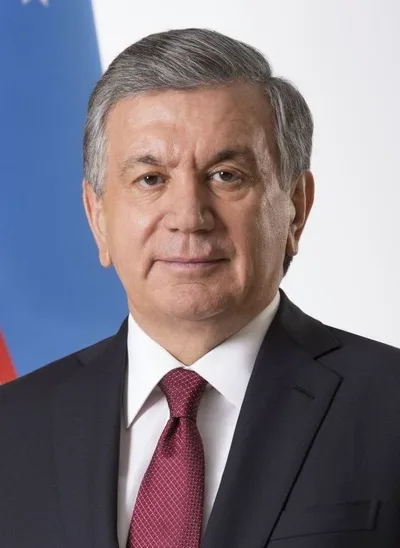
Born in Jizzakh region and Prime Minister for thirteen years before taking office, he has presided over a programme of economic opening and the removal of several long-standing Soviet-era restrictions.
From Zaamin to Tashkent
Shavkat Miromonovich Mirziyoyev was born on 24 July 1957 in the Zaamin district of the Jizzakh region. He graduated in 1981 from the Tashkent Institute of Irrigation and Agricultural Mechanization Engineers, earned a candidate's degree in technical sciences, and stayed on to teach and research, becoming the institute's vice-rector.
District, region, government
In 1990 he was elected to the Supreme Soviet of the Uzbek SSR. After independence he became hokim of Tashkent's Mirzo Ulugbek district (1992–1996), then hokim of the Jizzakh region (1996–2001) and of the Samarkand region (2001–2003).
In December 2003 he was appointed Prime Minister, and held the post for thirteen years — longer than anyone before him — running much of the day-to-day economy, including agriculture.
Becoming president
When Islam Karimov died in September 2016, parliament named Mirziyoyev acting president. He won the presidential election on 4 December 2016 and began almost at once to change direction: in his first months he opened a system of public reception offices and online appeals, through which citizens could complain directly to the presidency.
In September 2017 he became the first head of state to address the UN General Assembly in Uzbek.
Opening the economy
The most important single decision came on 5 September 2017, when the som was floated and a free currency market restored, ending two decades of a black-market exchange rate. The Development Strategy for 2017–2021 set the agenda: fewer controls, private enterprise, foreign investment and tax reform.
The country opened to travellers too. Exit visas for Uzbek citizens were abolished from 2019, visa-free entry was extended to dozens of countries, and tourism grew several times over.
Neighbours and cotton
Relations with Central Asian neighbours were rebuilt: closed border crossings reopened, flights and trains to Tajikistan resumed, and long-running border disputes were settled with Kyrgyzstan and Tajikistan.
At home, the forced mobilisation of students, teachers and doctors for the cotton harvest was ended. In 2022 the International Labour Organization confirmed that systemic forced labour had been eliminated from the harvest, and international boycotts of Uzbek cotton were lifted.
New Uzbekistan
Mirziyoyev frames his programme as "New Uzbekistan". Its landmarks include the Centre of Islamic Civilization in Tashkent, a network of presidential and creative schools, and a renewed interest in the Jadids — the reformers of a century ago, now honoured with a State Museum of Jadid Heritage in Bukhara.
A new constitution, approved by referendum on 30 April 2023, extended the presidential term to seven years; he won an early election that July. The strategy "Uzbekistan–2030" sets the next goals.
Limits and controversies
The reforms have not been without limits. In July 2022, protests in Nukus against proposed changes to Karakalpakstan's constitutional status left at least 21 people dead; the changes were withdrawn. Rights groups acknowledge real change since 2016, but say that independent political parties and the press remain tightly constrained.
He is married to Ziroatxon Hoshimova. For supporters, his presidency marks the moment Uzbekistan opened to the world; for critics, the opening is still unfinished.
Key achievements
- Oversaw the floating of the som in 2017, unifying the exchange rate
- Abolished exit visas in 2019 and extended visa-free entry to over ninety countries
- Presided over reforms that ended systemic forced labour in the cotton harvest