
The full story
Baha al-Din Naqshband
Balogardon — the averter of misfortune
1318 – 1389
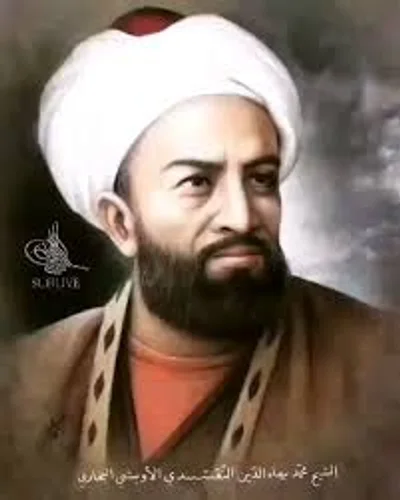
Founder of the Naqshbandi order, one of the most widespread Sufi paths in the world, known for its motto 'the heart with God, the hands at work'. His memorial complex near Bukhara is a major place of pilgrimage.
The pattern-maker's son
Muhammad Baha al-Din was born in 1318 in Qasr-i Hinduvan, a village near Bukhara later renamed Qasr-i Arifon — "the palace of the knowers of God". His name Naqshband, "the pattern-maker", recalls his family's craft of weaving patterned cloth. He grew up among the Khwajagan, the masters of Central Asian Sufism, and was trained by Sayyid Amir Kulal, a potter and a wrestler as well as a spiritual guide.
The silence of the heart
His great change was to make the practice quiet. Where other orders gathered for loud chanting, he taught the silent remembrance of God in the heart, kept up in the middle of ordinary life — at the market, at work, at home. "The heart with God, the hands at work" became the motto of an order that spread from Bukhara to India, the Ottoman lands and beyond.
Bukhara's place of pilgrimage
He died in 1389 and was buried in his home village. The complex that grew around his grave — mosques, a khanaka, a pool and shaded courtyards — was restored after independence and again receives pilgrims from across the Muslim world. A local saying holds that three visits to Bahouddin are worth a lesser pilgrimage.
Key achievements
- Founded the Naqshbandi order, one of the most widespread Sufi paths in the world
- Taught silent remembrance of God in the heart instead of loud chanting
- Summed up his way in the motto "the heart with God, the hands at work"