
The full story
Zahiriddin Muhammad Babur
Founder of the Mughal Empire
1483 – 1530
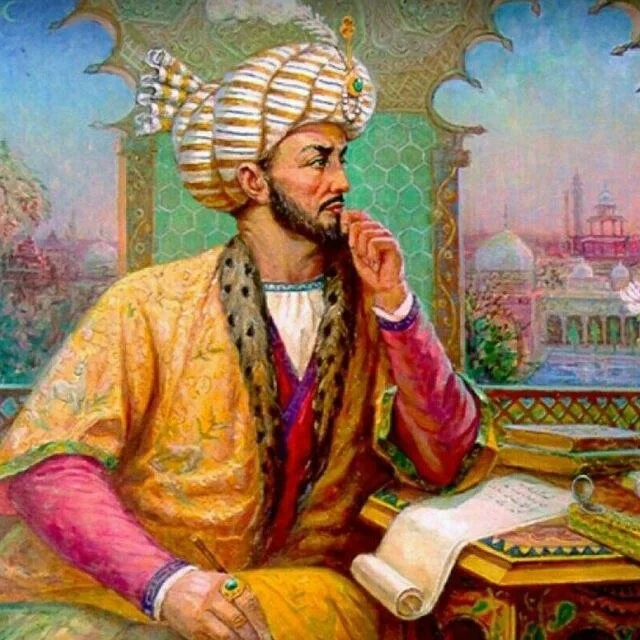
He inherited Fergana at twelve, lost it, took Kabul, then India — and wrote it all down with a candour almost no ruler has matched, including how much he missed Andijan's melons.
A king without a kingdom
Zahir al-Din Muhammad Babur was born in Andijan in 1483, descended from Timur on his father's side and from Genghis Khan on his mother's. When his father died in 1494 the boy became ruler of Fergana. He took Samarkand twice and lost it twice, and by 1501 he was a king without a kingdom, moving through the mountains with a few hundred followers.
Kabul and Panipat
In 1504 he took Kabul, which became his base for twenty years. Turning south, in April 1526 at Panipat he defeated the far larger army of Sultan Ibrahim Lodi, using field guns and a barricade of carts, and took Delhi and Agra. The dynasty he founded — the Baburids, known to the world as the Mughals — ruled much of the Indian subcontinent for more than three centuries.
The Baburnama
Babur wrote his memoirs in Chagatai Turkic with rare frankness: his defeats, his doubts, his love of gardens and of the melons of Fergana, his own poems. The Baburnama is among the first true autobiographies in Islamic literature. He died in Agra in 1530; at his wish his body was later taken to Kabul and buried in the garden that now bears his name.
Key achievements
- Won the Battle of Panipat in 1526 and founded the Mughal Empire
- Wrote the Baburnama, among the first true autobiographies of the Islamic world
- A poet in both Chagatai Turkic and Persian