
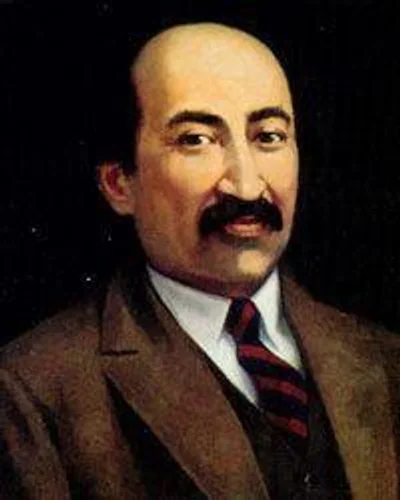
Abdurauf Fitrat was born in Bukhara in 1886. After studying in local madrasas he spent 1909 to 1913 in Istanbul, where his reformist thinking took its mature shape. He returned to write the movement's fiercest polemics, arguing that Bukhara's decline was the fault of Bukhara rather than of outsiders — a case that made him enemies on every side of it. He became a leading Young Bukharan and held ministries in the Bukharan People's Soviet Republic, then turned to scholarship in literature, linguistics and music. He was executed in the purges in 1938.
Istanbul, and a mind rearranged
Fitrat was born in Bukhara in 1886 and trained in its madrasas, then spent 1909 to 1913 in Istanbul — years that turned a devout student into the movement's sharpest polemicist. He returned writing dialogues and treatises that attacked the Emirate's clergy not from outside Islam but from within it, arguing that stagnation was the betrayal of the faith rather than its defence. That line of attack was far more dangerous to the old order than any secular critique, and it made him its most hated opponent.
Minister, scholar, defendant
After the Emirate fell, Fitrat held senior posts in the Bukharan People's Soviet Republic, including education and foreign affairs, and then turned to scholarship — literary history, linguistics, music theory, and the recovery of classical Chagatai texts that the new orthodoxy was already dismissing. That scholarly turn did not save him. Arrested in the purges, he was executed in 1938, in the same wave that took Qodiriy and Cho'lpon. His works were banned for half a century and only republished after 1991.
Key achievements
- Wrote Munozara (1911), a debate in print on reform and education
- Led work on modernising and standardising written Uzbek
- Professor and playwright; executed in 1938