
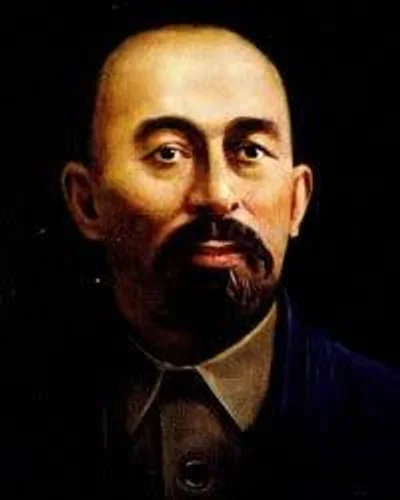
Abdulla Avloniy was born in Tashkent in 1878. Despite a difficult childhood he studied hard and became a leading teacher and writer. He opened new-method schools, wrote the textbooks Birinchi Muallim (The First Teacher) and Turkiy Guliston yoki Axloq (A Turkic Rose Garden, or Ethics), and founded newspapers. He also organised one of the first Uzbek theatre troupes and wrote plays attacking ignorance and harmful custom. He continued educational work through the 1920s and died in Tashkent in 1934 — one of the few of his generation to die of natural causes.
A book about how to be a person
Turkiy Guliston yoki Axloq, published in 1913, is the work Avloniy is still read for. It is a school ethics textbook, but written as a series of short essays on discrete virtues and vices — diligence, truthfulness, envy, cruelty to animals — each argued from reason and illustrated with verse. Nothing quite like it existed in Uzbek: it treated a child as someone who could be persuaded rather than merely instructed. Its most quoted line — that education is a matter of life or death for a nation — became the movement's shorthand for its whole programme.
The stage and the survivor
Alongside teaching, Avloniy built theatre. He organised the Turon troupe, wrote and adapted plays, and treated the stage as a classroom for adults who would never enter one. That combination — teacher, poet, publisher, playwright — was typical of the Jadids, who had no institutions and so had to be several at once. He was also, unusually, spared: he died in Tashkent in 1934, three years before the purge that killed Qodiriy, Cho'lpon and Fitrat. His schools were absorbed into the Soviet system, and his ethics textbook waited until independence to be widely reprinted.
Key achievements
- Wrote Turkiy Guliston yoki Axloq (1913), the first systematic Uzbek work on ethics and pedagogy
- Founded and taught in new-method schools in Tashkent for over three decades
- Organised one of the first Uzbek theatre troupes and wrote plays for its repertoire